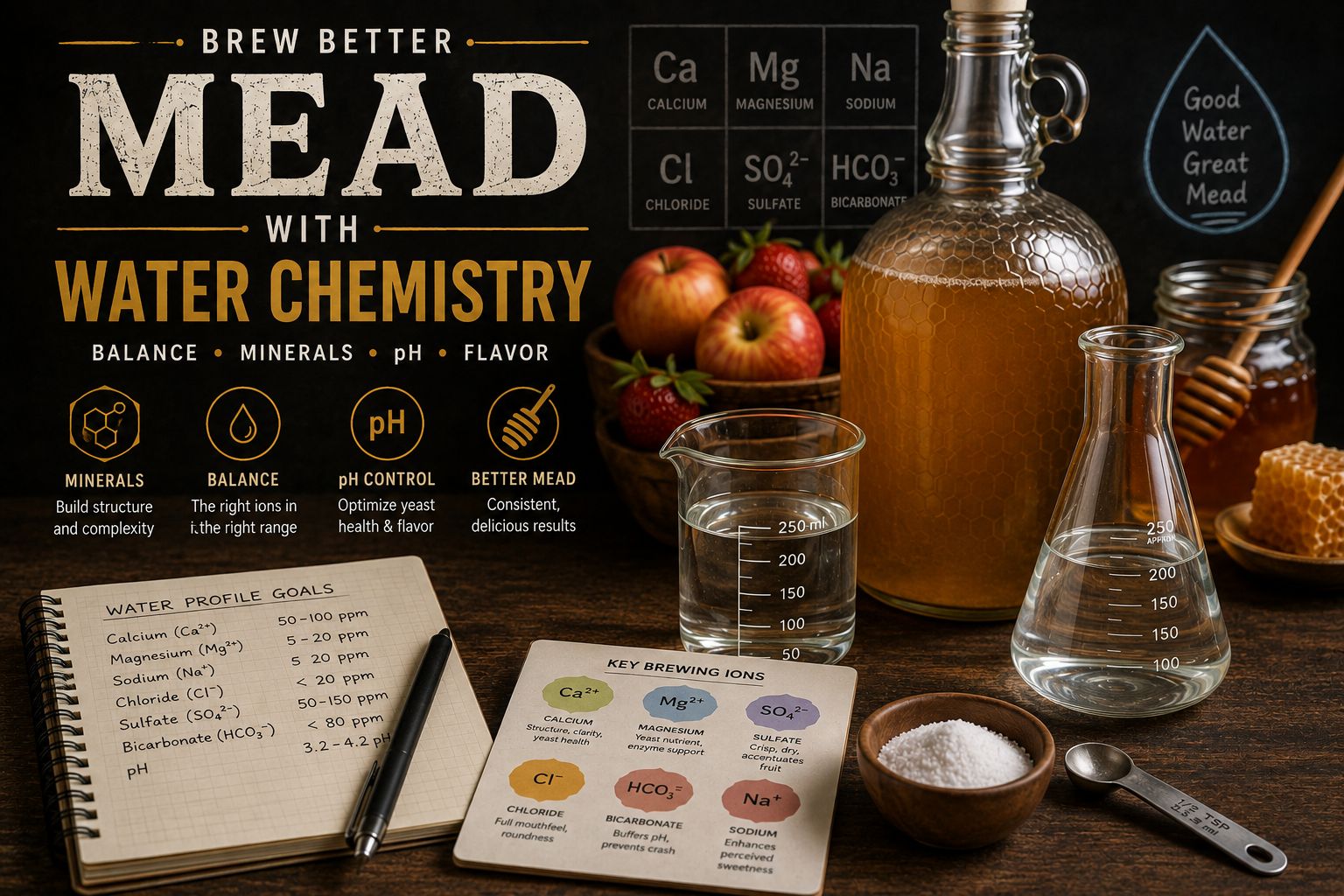
What Is Water Chemistry?
Water chemistry is the practice of understanding and adjusting the mineral content of your brewing water to achieve specific flavor outcomes. It's the difference between mead that tastes flat and inconsistent, and mead that sings with clarity, balance, and intention.
Mead is basically honey and water. Yeast does the fermentation work. So why does water matter? Because the minerals dissolved in your water directly affect:
- Yeast health and fermentation performance — certain ions are essential nutrients
- pH of the must — which affects flavor extraction, yeast activity, and stability
- Perceived sweetness and dryness — some ions enhance sweetness, others accentuate dryness
- Flavor clarity and finish — the right balance makes flavors pop; the wrong one muddies them
Why I Started Caring About Water Chemistry
For my first batches, I used tap water straight from the tap. Some batches turned out great. Others tasted off — dull, slightly sour, or just "wrong." I couldn't figure out the pattern until I started testing my water and tracking mineral additions.
The breakthrough came when I realized: my tap water changes seasonally. Municipal sources shift between groundwater and surface water throughout the year. My process was consistent; my water wasn't.
Once I started building water profiles from a neutral base (distilled or RO water) and adding minerals intentionally, my mead became consistent. Every batch. Same yeast, same honey, same process — but now the water was a variable I controlled, not a variable that controlled me.
The Chloride-to-Sulfate Ratio
This is the single most important concept in water chemistry for mead. The ratio between chloride and sulfate determines whether your mead tastes full and sweet or dry and crisp:
| Ratio (Cl⁻:SO₄²⁻) | Character | Best For |
|---|---|---|
| 1:1 | Balanced | Traditional dry meads |
| 2:1 | Fuller, sweeter | Sweet meads, fruit meads |
| 1:2 | Drier, crisper | Dry traditional, show meads |
| 3:1+ | Very full | Dessert meads, sack meads |
If your mead tastes thin or overly dry, increase chloride or decrease sulfate. If it tastes cloying or heavy, increase sulfate or decrease chloride.
pH and Why It Matters
Target pH for mead must: 3.2–4.2. Ideal range: 3.4–3.8.
Why?
- Below 3.2: Yeast struggles, fermentation stalls, flavors become sharp
- Above 4.2: Bacteria can thrive, flavors become dull, instability increases
Bicarbonate is your primary pH buffer. It prevents the pH from crashing too low during fermentation. But too much bicarbonate raises the starting pH and can make the mead taste chalky.
I test pH at three points: after mixing the must, 24 hours into fermentation, and at bottling. If the initial pH is above 4.0, I add a small amount of acid blend. If it's below 3.2, I add bicarbonate or reduce acidic fruit additions.
The Brewer's Salt Kit
Before diving into the individual minerals, here's the complete shopping list. These are the salts you'll use throughout this series — every ion is added via one of these common, inexpensive items:
| Ion(s) Added | Salt Name | Chemical Formula | Where to Buy |
|---|---|---|---|
| Calcium + Chloride | Calcium Chloride | CaCl₂·2H₂O | Homebrew shops, Amazon |
| Calcium + Sulfate | Gypsum | CaSO₄·2H₂O | Homebrew shops, Amazon |
| Magnesium + Sulfate | Epsom Salt | MgSO₄·7H₂O | Pharmacy, grocery store |
| Sodium + Chloride | Non-Iodized Table Salt | NaCl | Grocery store (kosher or pickling salt) |
| Sodium + Bicarbonate | Baking Soda | NaHCO₃ | Grocery store |
| Bicarbonate (no sodium) | Potassium Bicarbonate | KHCO₃ | Homebrew shops, Amazon |
| Bicarbonate + Calcium | Chalk | CaCO₃ | Homebrew shops (less recommended — hard to dissolve) |
That's it. These salts cover every ion you need. Total cost: under $20 for amounts that last dozens of batches.
What I keep on my shelf:
- Calcium chloride
- Gypsum
- Epsom salt
- Non-iodized table salt (kosher salt)
- Baking soda
- Potassium bicarbonate (optional — only if you want buffering without sodium)
I store each in a small labeled jar with the ion name and dosage rate written on top. A 0.01g digital scale ($10–15 on Amazon) is essential — you'll be measuring 0.1g quantities for 1-gallon batches.
Equipment note: Always mix your must in stainless steel, glass, or food-grade plastic vessels. Avoid aluminum — the acidic pH of mead must (3.2–4.2) reacts with aluminum, leaching metal ions into your brew and creating off-flavors.
It sounds fussy. It's not. It takes 10 minutes to mix minerals into your strike water, and it's the difference between mead that's good sometimes and mead that's great every time.
Comments