Why Distilled Water?
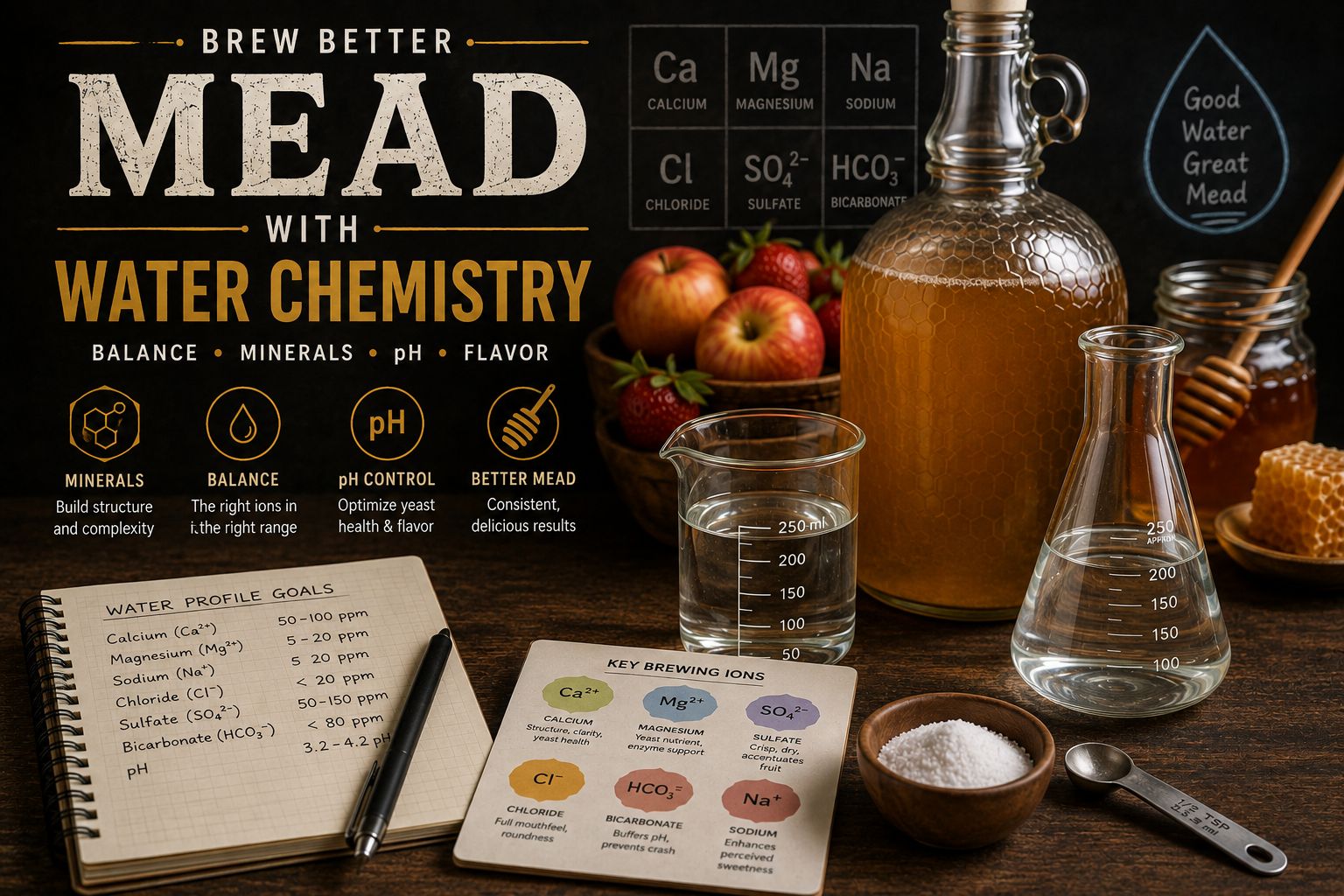
If you've read through the mineral articles in this series, you now know what each ion does and how to add it. But knowing the ingredients isn't the same as knowing the recipe. This article is the recipe — how to combine salts into a complete water profile for a specific mead style.
Start with distilled or RO water. Always.
Distilled water has zero dissolved minerals. That means zero calcium, zero magnesium, zero sodium, zero chloride, zero sulfate, zero bicarbonate. It's a blank canvas. Every ion in your finished water is there because you put it there intentionally. No guesswork. No seasonal variation. No surprises.
Tap water is unpredictable. Municipal sources shift between groundwater and surface water throughout the year. Well water is worse — often loaded with iron, sulfur, or excessive minerals that fight your adjustments. Even if you have a water report, it's an annual average. Your actual water on brew day might be completely different.
When you start from distilled, your calculations are exact. When you start from tap water, you're subtracting unknown values from your targets — and hoping the report is still accurate.
I buy distilled water at the grocery store for about $1 per gallon. For a 1-gallon batch, that's a one-dollar investment that eliminates the single biggest variable in mead making.
The Target Profiles
Here are four profiles I use regularly. Each is designed for a 1-gallon batch starting from distilled water.
Balanced Traditional Mead
The all-purpose profile. Good for semi-sweet traditionals where you want full flavor without leaning too sweet or too dry.
| Ion | Target ppm |
|---|---|
| Calcium | 75 |
| Magnesium | 10 |
| Sodium | 10 |
| Chloride | 100 |
| Sulfate | 100 |
| Bicarbonate | 50 |
Chloride-to-sulfate ratio: 1:1 — balanced. This is where I recommend everyone start. Make a batch with this profile, taste it, then adjust from there.
Dry Traditional / Show Mead
Crisp, clean, bone-dry. High sulfate accentuates the dryness and lets honey character shine with clarity.
| Ion | Target ppm |
|---|---|
| Calcium | 75 |
| Magnesium | 10 |
| Sodium | 5 |
| Chloride | 50 |
| Sulfate | 150 |
| Bicarbonate | 40 |
Chloride-to-sulfate ratio: 1:3 — dry and crisp. Low chloride prevents fullness, high sulfate sharpens the finish. Minimal sodium — you don't need sweetness enhancement on a dry mead. Lower bicarbonate allows the pH to drop naturally, enhancing crispness.
Sweet Traditional / Sack Mead
Full, lush, velvety. High chloride rounds out the sweetness and creates a coating mouthfeel.
| Ion | Target ppm |
|---|---|
| Calcium | 75 |
| Magnesium | 10 |
| Sodium | 15 |
| Chloride | 150 |
| Sulfate | 50 |
| Bicarbonate | 60 |
Chloride-to-sulfate ratio: 3:1 — full and sweet. High chloride creates the lush mouthfeel. A touch more sodium enhances sweetness perception. Sulfate is kept low so it doesn't fight the sweetness. Slightly higher bicarbonate to keep pH stable through a longer fermentation.
Fruit Mead (Melomel)
Jammy, bright, full. Chloride provides the body for fruit character, while moderate sulfate keeps flavors defined rather than muddy.
| Ion | Target ppm |
|---|---|
| Calcium | 90 |
| Magnesium | 10 |
| Sodium | 10 |
| Chloride | 120 |
| Sulfate | 80 |
| Bicarbonate | 70 |
Chloride-to-sulfate ratio: ~1.5:1 — full but not heavy. Calcium is bumped to 90 ppm to help with clarification (fruit adds pectin and proteins). Higher bicarbonate to buffer against the acids naturally present in fruit. Sulfate is moderate — enough to keep fruit flavors bright without drying the mead out.
Per-Mineral Quick Reference
Before walking through the full calculation, here's a quick reference for each mineral showing the salt I use, the target ppm, and the amount for a 1-gallon batch. These are the same numbers used in the worked example below — this section just breaks them out by mineral so you can see each addition in isolation.
Calcium (target: 75 ppm)
| Profile | Salt | Amount (1 gal) | Adds |
|---|---|---|---|
| Balanced (1:1) | Calcium Chloride | 0.6g | 43 ppm Ca, 76 ppm Cl |
| Gypsum | 0.4g | 24 ppm Ca, 59 ppm SO₄ | |
| Full/sweet (2:1) | Calcium Chloride | 0.8g | 58 ppm Ca, 101 ppm Cl |
| Gypsum | 0.3g | 18 ppm Ca, 44 ppm SO₄ | |
| Dry/crisp (1:2) | Calcium Chloride | 0.3g | 22 ppm Ca, 38 ppm Cl |
| Gypsum | 0.8g | 49 ppm Ca, 117 ppm SO₄ |
Magnesium (target: 10 ppm)
| Salt | Amount (1 gal) | Adds |
|---|---|---|
| Epsom Salt | 0.38g | 10 ppm Mg, 39 ppm SO₄ |
| Magnesium Chloride | 0.31g | 10 ppm Mg, 29 ppm Cl |
I use Epsom salt — it's cheap, available at any pharmacy, and the sulfate addition at these doses is modest. One bag has lasted me over a year.
Sodium (target: 10 ppm)
| Salt | Amount (1 gal) | Adds |
|---|---|---|
| Table Salt (non-iodized) | 0.1g | 10 ppm Na, 16 ppm Cl |
| Baking Soda | 0.14g | 10 ppm Na, 27 ppm HCO₃ |
I use table salt for sweet meads where I also want a chloride bump. For balanced meads where I just want the sweetness enhancement, I use baking soda.
Chloride (target: 100 ppm)
| Method | Salt | Amount (1 gal) | Adds |
|---|---|---|---|
| Primary | Calcium Chloride | 0.7g | 89 ppm Cl, 50 ppm Ca |
| Split (sweet) | Calcium Chloride | 0.6g | 76 ppm Cl, 43 ppm Ca |
| Table Salt | 0.16g | 26 ppm Cl, 17 ppm Na |
Calcium chloride is my primary method — it hits chloride and calcium at the same time. For sweet meads, I split with table salt to add sodium's sweetness enhancement.
Sulfate (target: 100 ppm)
| Method | Salt | Amount (1 gal) | Adds |
|---|---|---|---|
| Primary | Gypsum | 0.7g | 103 ppm SO₄, 43 ppm Ca |
| Split (with Mg) | Gypsum | 0.41g | 60 ppm SO₄, 25 ppm Ca |
| Epsom Salt | 0.38g | 39 ppm SO₄, 10 ppm Mg |
Gypsum is my go-to for dry traditional meads. When I also need magnesium, I split with Epsom salt to hit both targets at once.
Bicarbonate (target: 50 ppm)
| Salt | Amount (1 gal) | Adds |
|---|---|---|
| Baking Soda | 0.26g | 50 ppm HCO₃, 19 ppm Na |
| Potassium Bicarbonate | 0.31g | 50 ppm HCO₃, 32 ppm K |
| Chalk | 0.31g | 50 ppm HCO₃ equiv, 33 ppm Ca |
Potassium bicarbonate is my preferred method — it gives pure buffering without adding sodium or calcium. Baking soda works if you don't mind the sodium. Chalk is less reliable because it doesn't dissolve easily.
Calculating Salt Additions
Now for the math. Each salt adds two ions. You need to solve for all six ions simultaneously. Here's how I do it — step by step for a 1-gallon batch.
Dosage Reference
Before doing any math, you need to know how much of each ion a given amount of salt actually delivers. The table below shows how many parts per million (ppm) of each ion one gram of salt adds to one gallon of water. These values are constants — they come from the molecular weight of each salt and don't change:
| Salt | Per gram per gallon adds |
|---|---|
| Calcium Chloride (CaCl₂·2H₂O) | 72 ppm Ca + 127 ppm Cl |
| Gypsum (CaSO₄·2H₂O) | 61 ppm Ca + 147 ppm SO₄ |
| Epsom Salt (MgSO₄·7H₂O) | 26 ppm Mg + 103 ppm SO₄ |
| Table Salt (NaCl) | 104 ppm Na + 160 ppm Cl |
| Baking Soda (NaHCO₃) | 72 ppm Na + 192 ppm HCO₃ |
| Potassium Bicarbonate (KHCO₃) | 161 ppm HCO₃ (+ 103 ppm K, negligible flavor) |
How to use this table: The formula is simple. Divide your target ppm by the ppm-per-gram value from the table to get the grams of salt you need:
grams of salt = target ppm ÷ ppm added per gram per gallon
For example, if your magnesium target is 10 ppm and the table says Epsom salt adds 26 ppm Mg per gram per gallon, you need 10 ÷ 26 = 0.38g. Every step in the worked example below uses this same formula.
Where the dosage numbers come from: Each value in the table is derived from the salt's molecular weight — the percentage of the salt's mass that each ion represents. Take Epsom salt (MgSO₄·7H₂O) as an example. Its molecular weight is about 246 g/mol. Magnesium has an atomic weight of 24, so magnesium accounts for 24 ÷ 246 = 9.8% of the salt's mass. One gram dissolved in one gallon (3.785 liters) gives 1,000 mg ÷ 3.785 L = 264 mg/L. Multiply by the magnesium fraction: 264 × 0.098 = 26 ppm — the number in the table. The same calculation applies to every ion in every salt. These aren't estimates or rules of thumb; they're chemistry.
Worked Example: Balanced Traditional Mead (1 gallon)
Targets: Ca 75, Mg 10, Na 10, Cl 100, SO₄ 100, HCO₃ 50
The order matters here. I start with salts that only provide one ion I need (magnesium, bicarbonate, sodium), then handle the two-salt split for calcium, chloride, and sulfate last — because by that point I know exactly how much chloride and sulfate have already been accounted for.
Step 1: Magnesium. Only Epsom salt provides magnesium, so it goes first.
- Target: 10 ppm Mg
- From the dosage table: Epsom salt adds 26 ppm Mg per gram per gallon
- Grams needed: 10 ÷ 26 = 0.38g
- Epsom salt also adds sulfate — 103 ppm SO₄ per gram per gallon (same table, same row). So 0.38g × 103 = 39 ppm sulfate comes along for the ride. I'll subtract that from the sulfate target in Step 4.
Step 2: Bicarbonate. Use potassium bicarbonate, which adds bicarbonate without sodium.
- Target: 50 ppm HCO₃
- From the dosage table: potassium bicarbonate adds 161 ppm HCO₃ per gram per gallon
- Grams needed: 50 ÷ 161 = 0.31g
- Potassium is also added (103 ppm per gram), but at 0.31g that's only 32 ppm potassium — no flavor impact at these levels.
Step 3: Sodium. Use table salt.
- Target: 10 ppm Na
- From the dosage table: table salt adds 104 ppm Na per gram per gallon
- Grams needed: 10 ÷ 104 = 0.10g
- Table salt also adds chloride — 160 ppm Cl per gram per gallon. So 0.10g × 160 = 16 ppm chloride. I'll subtract that from the chloride target in Step 4.
Step 4: Calcium + Chloride + Sulfate (remaining). After steps 1–3, three ions are already partially filled:
- Calcium needed: 75 ppm (nothing added yet)
- Chloride needed: 100 − 16 (from table salt) = 84 ppm
- Sulfate needed: 100 − 39 (from Epsom salt) = 61 ppm
Calcium chloride and gypsum both add calcium, so I split the calcium between them. Calcium chloride handles the remaining chloride, and gypsum handles the remaining sulfate.
Calcium chloride for chloride:
- Target chloride: 84 ppm
- From the dosage table: calcium chloride adds 127 ppm Cl per gram per gallon
- Grams needed: 84 ÷ 127 = 0.66g
- Calcium chloride also adds calcium — 72 ppm Ca per gram per gallon. So 0.66g × 72 = 48 ppm calcium.
Gypsum for the remaining calcium and sulfate:
- Calcium remaining: 75 − 48 = 27 ppm
- From the dosage table: gypsum adds 61 ppm Ca per gram per gallon
- Grams needed: 27 ÷ 61 = 0.44g
- Gypsum also adds sulfate — 147 ppm SO₄ per gram per gallon. So 0.44g × 147 = 65 ppm sulfate.
- Sulfate check: 39 (Epsom) + 65 (gypsum) = 104 ppm — 4 ppm over target, which is close enough. At this scale, a few ppm either way is imperceptible.
Final salt additions for 1 gallon:
| Salt | Amount | Adds |
|---|---|---|
| Epsom Salt | 0.38g | 10 ppm Mg, 39 ppm SO₄ |
| Potassium Bicarbonate | 0.31g | 50 ppm HCO₃ |
| Table Salt (non-iodized) | 0.10g | 10 ppm Na, 16 ppm Cl |
| Calcium Chloride | 0.66g | 48 ppm Ca, 84 ppm Cl |
| Gypsum | 0.44g | 27 ppm Ca, 65 ppm SO₄ |
| Total | 1.89g | Ca 75, Mg 10, Na 10, Cl 100, SO₄ 104, HCO₃ 50 |
That's 1.89 grams of total salts for a full 1-gallon water profile. Weigh each one on a 0.01g scale, dissolve in your distilled water before adding honey, and you've got a precise, reproducible water profile.
The Process
- Buy 1 gallon of distilled water from the grocery store
- Weigh each salt on a 0.01g digital scale — set them out in small dishes
- Dissolve all salts in the distilled water and stir until fully dissolved
- Test pH — it should be around 6.5–7.5 (distilled water plus minerals). If below 6.0, add a pinch more bicarbonate. If above 7.5, don't worry — the honey will bring it down
- Add honey and mix thoroughly
- Test pH again — now you're looking for 3.4–3.8. Adjust with acid blend (lower) or bicarbonate (raise) if needed
- Pitch yeast and proceed with your normal fermentation process
The whole salt-mixing step takes about 10 minutes. It's the least time-consuming part of brewing, but it has the biggest impact on consistency.
Adjusting Profiles
Once you've brewed with the balanced profile, you'll start to develop a sense of what you want to change. Here's a quick adjustment guide:
Mead too thin? Increase chloride (+25 ppm) or calcium (+15 ppm).
Mead too sweet or cloying? Increase sulfate (+25 ppm) or decrease chloride (-25 ppm).
Mead too dry or sharp? Increase chloride (+25 ppm) or decrease sulfate (-25 ppm).
Mead won't clear? Increase calcium (+15 ppm). For fruit meads, persistent haze is often pectin — use pectic enzyme instead, as calcium won't clear pectin haze.
Fermentation sluggish? Check magnesium (should be 10+ ppm) and calcium (should be 50+ ppm).
Mead tastes flat? Your chloride-to-sulfate ratio might be too neutral. Push it one direction — more chloride for sweetness, more sulfate for crispness.
Keep notes on every batch. Record your salt additions, the resulting profile, and your tasting notes after fermentation. Over a few batches, patterns emerge. You'll learn which adjustments matter most to your palate, and your water profiles will become second nature.
A Note on Precision
At these small quantities (0.1g increments), measurement error matters. A slightly heavy scoop of table salt can add 30 ppm sodium instead of 10. Always use a digital scale with 0.01g resolution — not measuring spoons, not "a pinch." The difference between a great profile and a ruined one is often less than a gram.
If your scale has a tare function, use it. Place your weighing dish on the scale, tare to zero, then add salt until you hit the target. It eliminates the guesswork.
I keep a small notebook in my brewing area with each batch's salt additions recorded. When a batch turns out exceptional, I know exactly what water profile produced it. When a batch is off, I can check whether I made a dosing error. The notebook is cheap insurance against repeating mistakes.
Comments