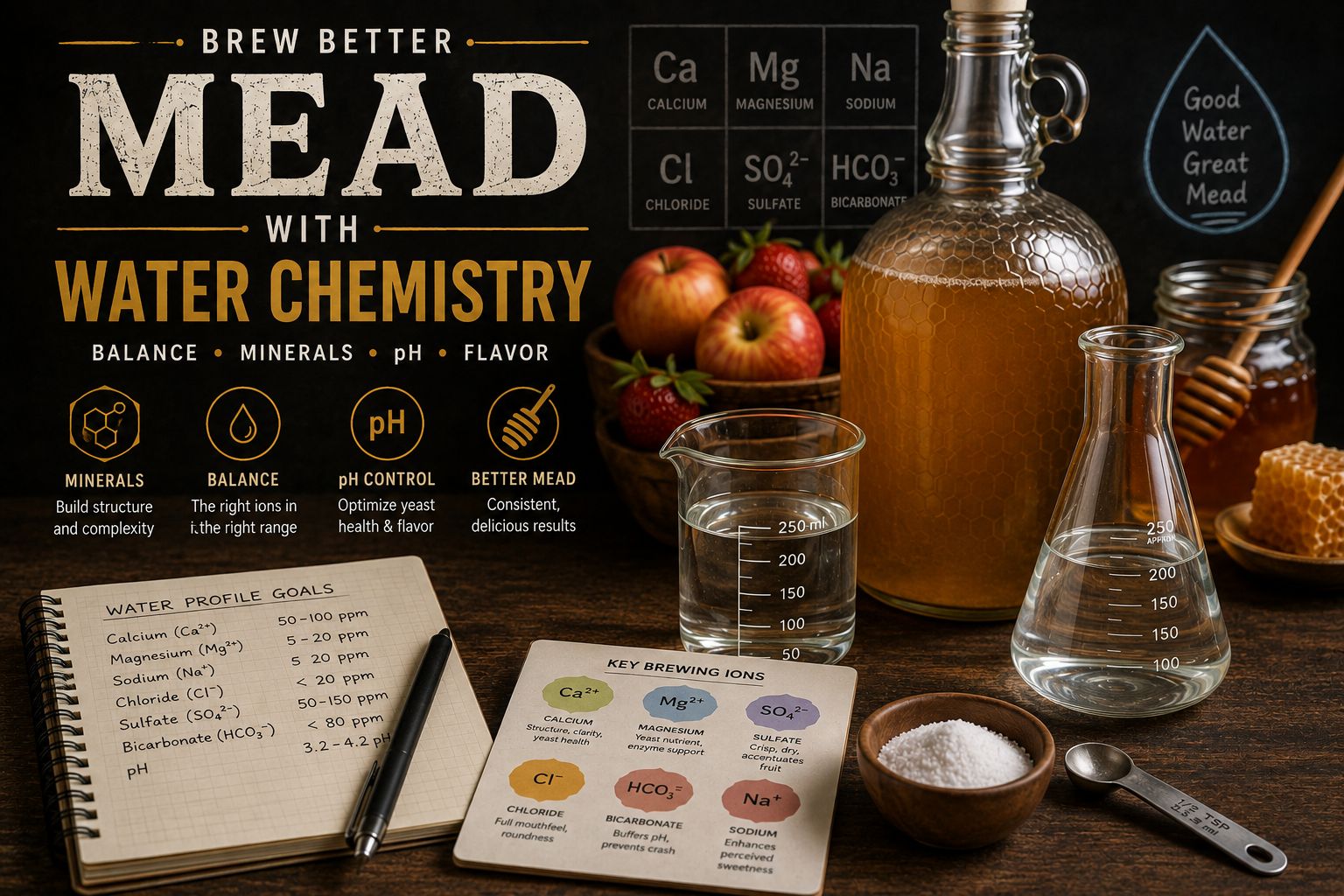
What Calcium Does
Calcium is the workhorse ion in mead making. It doesn't directly flavor your mead the way chloride or sulfate do, but it silently drives three critical processes:
Yeast health. Calcium strengthens yeast cell walls, improves flocculation (the process where yeast clumps together and drops out of suspension), and supports enzyme activity during fermentation. Without enough calcium, yeast can be sluggish, stall early, or fail to settle clear.
Clarity. Calcium reacts with proteins and polyphenols in the must, forming compounds that drop out of suspension. This is the same mechanism behind Irish moss or Whirlfloc in beer brewing. In mead, the effect is subtler — honey has fewer proteins than malt — but calcium still helps your mead clear faster and brighter.
Structure. Calcium adds a subtle structural quality to the mouthfeel. Not sweetness, not dryness — a backbone. Meads made with adequate calcium feel more "complete" on the palate. Too little and the mead can taste thin or watery, even at full strength.
When to Use It
Always. Every mead benefits from adequate calcium. There's no style where you'd deliberately keep calcium low. The question isn't whether to add it, but how much.
Signs your mead needs more calcium:
- Sluggish or stuck fermentation
- Mead won't clear after extended aging
- Thin, watery mouthfeel despite adequate ABV
- Yeast drops out too early (premature flocculation)
Target Range
50–100 ppm for most mead styles.
I aim for 75 ppm as my default. That's enough for robust yeast health without over-mineralizing the must. For fruit meads with high pectin content, I push to 100 ppm to help with clarification. Note: calcium can bind with pectin to cause haze in some cases, so if you're making a fruit mead and notice persistent cloudiness, try reducing calcium to 50-60 ppm and relying on pectic enzyme instead.
How to Add Calcium
Two primary salts:
Calcium Chloride (CaCl₂·2H₂O)
- Adds: Calcium + Chloride
- Best for: Sweet meads, fruit meads, full-bodied traditional meads
- Effect: Boosts calcium while also increasing chloride (fullness, sweetness)
- Dosage: 1 gram per gallon adds ~72 ppm calcium and ~127 ppm chloride
Gypsum (Calcium Sulfate, CaSO₄·2H₂O)
- Adds: Calcium + Sulfate
- Best for: Dry meads, show meads, crisp traditional meads
- Effect: Boosts calcium while also increasing sulfate (dryness, crispness)
- Dosage: 1 gram per gallon adds ~61 ppm calcium and ~147 ppm sulfate
Choosing between them: The decision is really about the chloride-to-sulfate ratio (covered in Part 1). If you want a fuller, sweeter mead, use calcium chloride. If you want a drier, crisper mead, use gypsum. Many mead makers use a combination of both to hit their target calcium without pushing either chloride or sulfate too high.
Common Mistakes
Adding too much. Calcium above 150 ppm can taste minerally or chalky. It also over-flocculates yeast, causing premature drop-out and incomplete fermentation. More is not better.
Forgetting to account for starting water. If your tap water already has 80 ppm calcium, adding 75 ppm more puts you at 155 — into the chalky zone. Always subtract your starting value from your target.
Using only one salt. If you dose all your calcium via gypsum, your sulfate skyrockets. If you dose all via calcium chloride, your chloride skyrockets. Splitting between both salts gives you control over the ratio while hitting your calcium target.
Ignoring calcium in fruit meads. Fruit adds its own minerals, particularly potassium, which can interfere with calcium uptake by yeast. I always boost calcium slightly higher (90–100 ppm) in fruit meads to compensate.
Comments