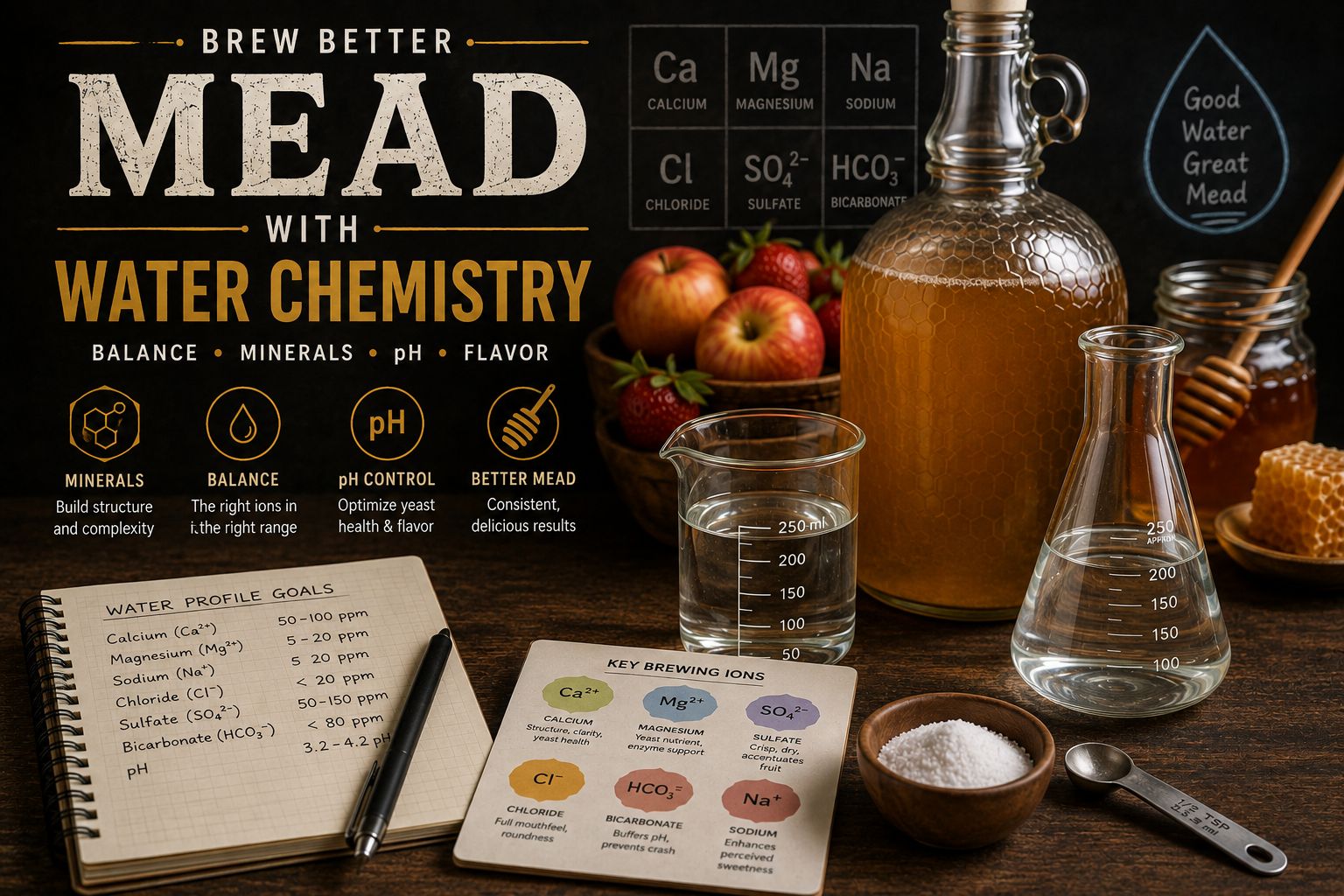
What Sodium Does
Sodium is a flavor enhancer. In the right amounts, it makes sweetness taste sweeter and roundness feel rounder — the same way a pinch of salt makes caramel or chocolate taste more intense. In mead, sodium enhances the perception of honey sweetness without adding actual sugar.
Perceived sweetness. Sodium reduces the perception of bitterness and astringency while amplifying sweetness. This is why a tiny pinch of salt in coffee reduces bitterness, and why bakers add salt to cookie dough. In mead, 10–20 ppm sodium makes a semi-sweet mead taste more luscious without increasing residual sugar.
Mouthfeel. Small amounts of sodium contribute to a soft, round mouthfeel. It works synergistically with chloride — together they create a full, velvety quality that's hard to achieve otherwise.
Yeast impact. Unlike calcium and magnesium, sodium isn't a yeast nutrient. At high levels, it actually inhibits yeast activity and can slow fermentation. Keep it low.
When to Use It
Use sodium when:
- Making sweet or dessert meads where you want maximum sweetness perception
- Your mead tastes thin or "sour" despite adequate sweetness
- You're aiming for a soft, round profile (melomels, sack meads)
Skip sodium when:
- Making dry traditional meads (sodium muddies the crisp, clean character)
- Your water already has 20+ ppm sodium
- You're on a low-sodium diet (yes, this matters to some readers)
Target Range
5–25 ppm for mead.
This is a tight range with a hard ceiling. Below 5 ppm, sodium contributes nothing. Above 50 ppm, sodium tastes salty, harsh, and metallic. The sweet spot is 10–15 ppm — enough to enhance sweetness without being detectable as "saltiness."
I target 10 ppm as my standard. For dessert meads, I push to 15 ppm. I never exceed 25 ppm.
How to Add Sodium
Table Salt (NaCl, non-iodized)
- Adds: Sodium + Chloride
- Best for: Sweet meads, fruit meads where you also want chloride boost
- Effect: Enhances sweetness while adding chloride (fullness)
- Dosage: 1 gram per gallon adds ~104 ppm sodium and ~160 ppm chloride
Critical: Use non-iodized salt only. Iodized salt can cause off-flavors and inhibit yeast. Kosher salt or pickling salt works — just check the label.
Baking Soda (Sodium Bicarbonate, NaHCO₃)
- Adds: Sodium + Bicarbonate
- Best for: When you want sodium without chloride (or need to raise pH)
- Effect: Enhances sweetness while buffering pH
- Dosage: 1 gram per gallon adds ~192 ppm bicarbonate and ~72 ppm sodium
Use baking soda when your chloride is already on target but you still want sodium's sweetness enhancement. It also raises pH — useful if your must is too acidic.
Common Mistakes
Using too much. This is the easiest mineral to overdo. The difference between "enhanced sweetness" and "this tastes salty" is 15 ppm. Measure with a 0.01g scale. A slightly heavy pinch of salt can push a 1-gallon batch from 10 ppm to 40 ppm — into the salty zone.
Using iodized salt. Iodine is a yeast inhibitor and produces medicinal off-flavors. It's labeled clearly on the package — just check. Kosher salt, pickling salt, and sea salt (without additives) are all fine.
Ignoring sodium in tap water. Municipal water reports often show sodium levels of 20–100 ppm, especially in areas using water softeners. If your tap water already has 30 ppm sodium, adding more is unnecessary and potentially harmful. Check your report first.
Confusing sodium with saltiness. At brewing concentrations (5–25 ppm), sodium doesn't taste salty. It enhances sweetness and rounds out flavors. Don't be afraid of it — just respect the range.
Adding sodium to dry meads. Sodium softens the character of a mead. In a dry traditional, you want crispness and clarity, not softness and roundness. Save sodium for sweet and full-bodied styles.
Sodium and Water Softeners
If your home has a water softener, your sodium levels are likely very high. Water softeners work by replacing calcium and magnesium with sodium — meaning soft water can have 100+ ppm sodium.
Never use softened water for mead. The sodium levels are far too high and the calcium/magnesium have been stripped out. If you have a softener, either:
- Bypass it for your brewing water (most systems have a bypass valve)
- Use an outdoor spigot that's pre-softener
- Use distilled or RO water instead
I learned this the hard way. A batch made with softened water tasted flat and slightly salty, with sluggish fermentation. The sodium was over 80 ppm. Now I always pull brewing water from the bypass tap.
Comments