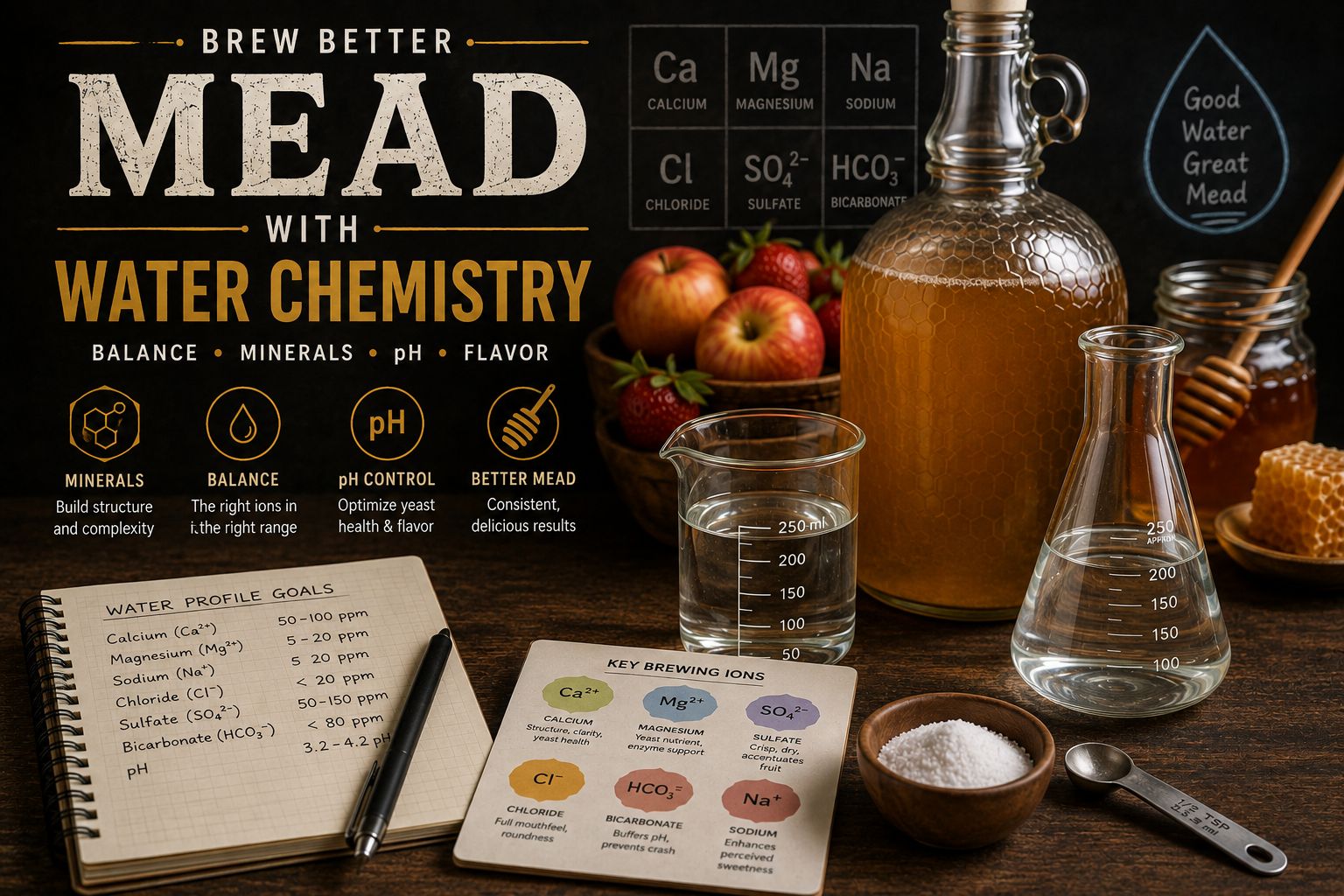
What Bicarbonate Does
Bicarbonate is the pH guardian. It doesn't contribute flavor directly — its job is to keep your must from becoming too acidic during fermentation. Without adequate buffering, pH can crash below 3.0, stalling yeast and producing sharp, sour off-flavors.
pH buffering. As yeast ferments sugar, it produces CO₂, which forms carbonic acid in solution. Organic acids from honey and fruit additions also accumulate. Without a buffer, the pH drops steadily. Bicarbonate neutralizes these acids, holding the pH in the safe zone (3.2–4.2) where yeast thrives and flavors develop properly.
Fermentation stability. A stable pH means consistent fermentation. When pH crashes, yeast goes into stress mode — producing off-flavors, higher alcohols, and undesirable esters. Bicarbonate prevents this crash, giving yeast a stable environment to work in.
Alkalinity. Bicarbonate is the primary contributor to water's "alkalinity" — its resistance to pH changes. Your water report may list "Total Alkalinity as CaCO₃" rather than bicarbonate directly. Convert with: Bicarbonate (ppm) = Total Alkalinity (ppm as CaCO₃) × 1.22.
When to Use It
Use bicarbonate when:
- Starting with distilled or RO water (zero buffering capacity)
- Making fruit meads with high-acid fruit (citrus, berries, stone fruit)
- Your must pH is below 3.2 at pitching
- You've experienced pH crash in previous batches
Reduce or skip bicarbonate when:
- Your tap water already has high alkalinity (> 100 ppm as CaCO₃)
- Your must pH is above 4.0 — you don't need more buffering
- Making dry traditional meads where you want a crisp, sharp finish (lower pH enhances crispness)
Target Range
30–80 ppm for most mead styles.
| Mead Style | Target HCO₃⁻ | Reasoning |
|---|---|---|
| Traditional (dry) | 30–50 ppm | Light buffer, allows pH to drop for crispness |
| Traditional (sweet) | 50–80 ppm | Moderate buffer, prevents souring |
| Fruit mead (high acid) | 60–80 ppm | Extra buffer to counter fruit acids |
| Fruit mead (low acid) | 40–60 ppm | Moderate buffer, fruit adds some acidity |
| Dessert/sack mead | 50–70 ppm | Prevents cloying-sour combination |
I target 50 ppm as my default. For high-acid fruit meads (strawberry, cherry, citrus), I push to 70 ppm.
Ceiling: Above 100 ppm, bicarbonate raises the starting pH too high, can make the mead taste chalky, and may slow fermentation by making the environment too alkaline for yeast. Keep it moderate.
How to Add Bicarbonate
Baking Soda (Sodium Bicarbonate, NaHCO₃)
- Adds: Bicarbonate + Sodium
- Best for: Most situations — cheap, available, effective
- Effect: pH buffering + slight sweetness enhancement
- Dosage: 1 gram per gallon adds ~192 ppm bicarbonate and ~72 ppm sodium
Account for the sodium. At 50 ppm bicarbonate, you're also adding ~19 ppm sodium. That's within range but worth tracking. If you're already adding sodium via table salt, adjust accordingly.
Chalk (Calcium Carbonate, CaCO₃)
- Adds: Bicarbonate (indirectly) + Calcium
- Best for: When you want buffering without sodium
- Effect: pH buffering + calcium boost
- Dosage: 1 gram per gallon adds ~161 ppm bicarbonate equivalent and ~106 ppm calcium
Important: Chalk doesn't dissolve easily in water. It requires an acidic environment to go into solution. In practice, chalk is less effective than baking soda for pH adjustment in mead must because honey must isn't acidic enough at the start to dissolve it fully. I prefer baking soda.
Potassium Bicarbonate (KHCO₃)
- Adds: Bicarbonate + Potassium
- Best for: When you want buffering without sodium or calcium
- Effect: Pure pH buffering
- Dosage: 1 gram per gallon adds ~161 ppm bicarbonate and ~103 ppm potassium
Potassium bicarbonate is the cleanest option — no sodium, no calcium, just buffering. It's available at homebrew shops and online. Potassium doesn't affect flavor at these concentrations.
pH Management During Fermentation
Bicarbonate sets your starting pH buffer, but fermentation is dynamic. Here's how I manage pH throughout:
At must preparation: Mix minerals into water before adding honey. Test pH. Target 3.6–3.8. If above 4.0, add a small amount of acid blend or tartaric acid. If below 3.2, add more bicarbonate.
24 hours into fermentation: Test pH again. It should be dropping but not crashing. If below 3.0, add 0.5g potassium bicarbonate dissolved in water. If above 3.8, don't worry — it'll drop.
At bottling: Test final pH. Target 3.2–3.6. If too high, the mead may taste flat and unstable. If too low, it may taste sharp and sour. Post-fermentation pH adjustments are possible but tricky — prevention is better than correction.
Common Mistakes
Over-buffering. Too much bicarbonate raises the starting pH above 4.0, creating an environment where bacteria can compete with yeast. It also makes the mead taste chalky or soapy. Less is more — 50 ppm is usually plenty.
Under-buffering with distilled water. Distilled water has zero alkalinity. If you build a profile with distilled water and forget bicarbonate, the pH will crash during fermentation. I've done this. The mead tasted sharp and sour, and fermentation stalled at 8% ABV. Always include bicarbonate when starting from distilled or RO.
Confusing alkalinity with hardness. Hardness (calcium + magnesium) and alkalinity (bicarbonate) are independent. You can have hard water with low alkalinity, or soft water with high alkalinity. Your water report lists them separately. Don't assume one from the other.
Adding bicarbonate to high-alkalinity tap water. If your water report shows alkalinity above 100 ppm as CaCO₃, your water is already well-buffered. Adding more bicarbonate pushes the pH too high. Either dilute with distilled water or skip the bicarbonate addition entirely.
Ignoring pH during fermentation. Bicarbonate is a starting buffer, not a permanent one. It gets consumed as it neutralizes acids. If you have a long fermentation (high ABV mead), the buffer may deplete before fermentation finishes. Monitor pH at the 1/3 sugar break and adjust if needed.
Using chalk without dissolving it. Chalk that doesn't dissolve doesn't buffer. If you add chalk and it sits at the bottom of your vessel as a white powder, it's not working. Use baking soda or potassium bicarbonate instead — both dissolve readily.
Comments