What Sulfate Does
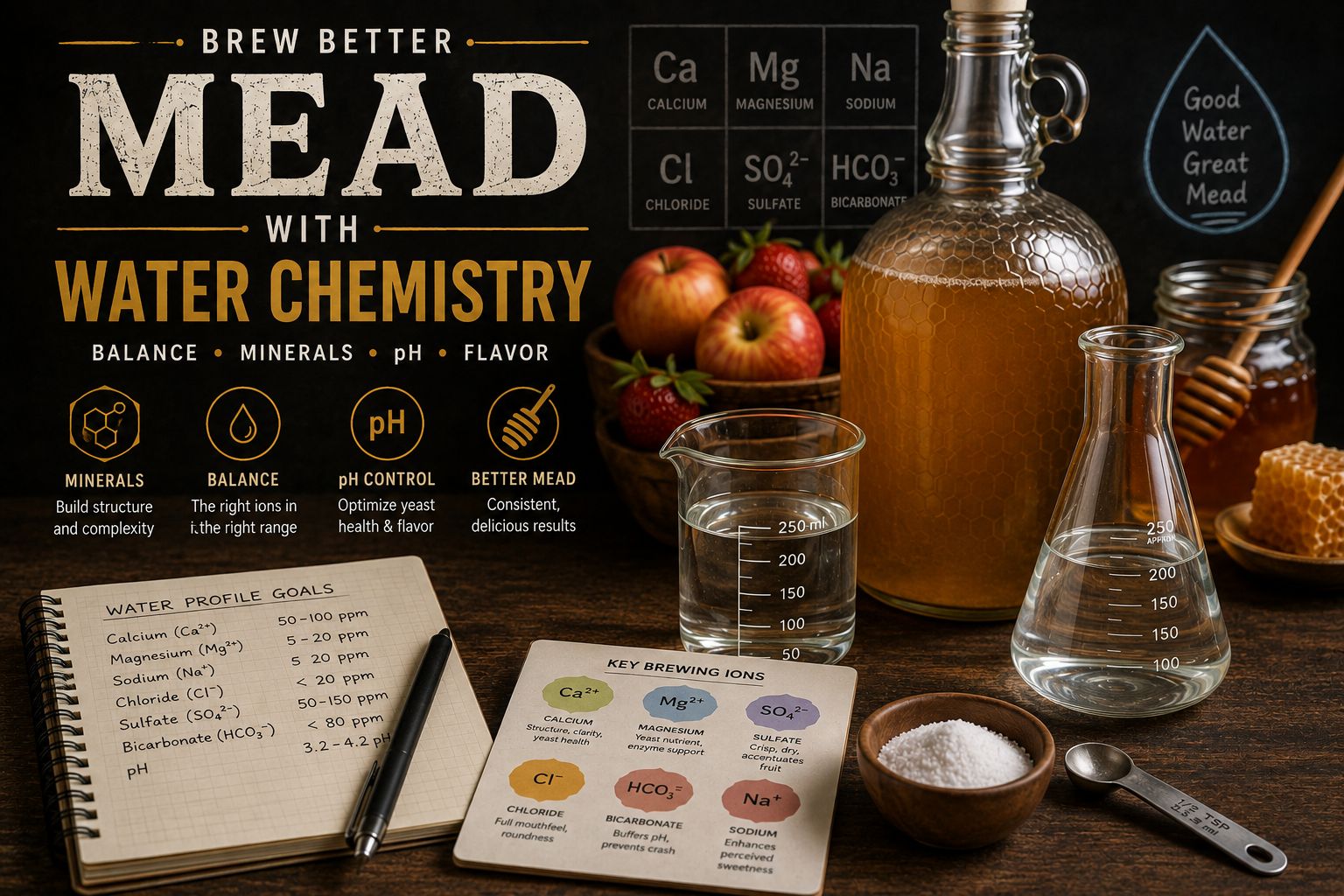
Sulfate is the "crispness" ion. It does the opposite of chloride — it dries out the palate, sharpens flavors, and accentuates fruit and floral notes. If your mead tastes cloying, heavy, or muddy, sulfate is usually the fix.
Dryness perception. Sulfate enhances the perception of dryness without actually reducing sugar. It creates a crisp, clean finish that makes a semi-dry mead taste fully dry, and a dry mead taste bone-dry. This is why dry traditional meads benefit from higher sulfate.
Flavor clarity. Sulfate acts like a magnifying glass for delicate flavors. Floral notes in a traditional mead become more distinct. Fruit character in a melomel becomes brighter and more defined. The overall effect is "clarity" — flavors separate and shine rather than blending together.
Not sulfite. Don't confuse sulfate (SO₄²⁻) with sulfite (SO₂). Sulfate is a mineral ion that affects flavor perception. Sulfite is a preservative added via Campden tablets to kill wild microbes or stabilize finished mead. They're completely different compounds with different purposes.
Hop analogy. In beer brewing, sulfate is associated with the crisp, dry character of pale ales and IPAs. In mead, the effect is similar but subtler — there are no hops to bitter, but sulfate still dries and sharpens the honey character.
When to Use It
Use sulfate when:
- Making dry traditional meads or show meads
- Your mead tastes cloying, heavy, or flat
- You want to accentuate fruit brightness in a melomel
- You're aiming for a crisp, clean, refreshing character
Reduce sulfate when:
- Making sweet meads or dessert meads (sulfate fights the sweetness)
- Your mead tastes thin, sharp, or astringent
- You want a soft, velvety profile
Target Range
50–150 ppm for most mead styles.
| Mead Style | Target SO₄²⁻ | Character |
|---|---|---|
| Dry traditional | 100–150 ppm | Crisp, clean, sharp finish |
| Semi-dry traditional | 75–100 ppm | Balanced with slight crispness |
| Semi-sweet traditional | 50–75 ppm | Soft dryness, not aggressive |
| Fruit mead (bright) | 75–100 ppm | Accentuates fruit brightness |
| Sweet/dessert mead | 25–50 ppm | Minimal — don't fight the sweetness |
I target 100 ppm for dry traditionals and 50 ppm for semi-sweets. For sweet meads, I keep sulfate as low as possible.
Ceiling: Above 200 ppm, sulfate can taste sulfury, harsh, or astringent. Some people are sensitive to sulfate and detect a mineral sharpness even at 150 ppm. If you taste something sharp and dry that shouldn't be there, back off the sulfate.
How to Add Sulfate
Gypsum (Calcium Sulfate, CaSO₄·2H₂O)
- Adds: Sulfate + Calcium
- Best for: Most situations — you usually need calcium too
- Effect: Dryness/crispness + yeast health + clarity
- Dosage: 1 gram per gallon adds ~147 ppm sulfate and ~61 ppm calcium
Gypsum is the primary sulfate source for mead makers. It's cheap, widely available, and doubles as a calcium source. If you're building a dry mead profile, gypsum does most of the heavy lifting.
Epsom Salt (Magnesium Sulfate, MgSO₄·7H₂O)
- Adds: Sulfate + Magnesium
- Best for: When calcium is already on target but you need more sulfate
- Effect: Dryness/crispness + yeast nutrient
- Dosage: 1 gram per gallon adds ~103 ppm sulfate and ~26 ppm magnesium
Epsom salt is very concentrated — use it in small amounts. At the doses needed for magnesium (0.2–0.4g/gallon), the sulfate contribution is 20–40 ppm, which can be a useful supplement to gypsum.
The Sulfate-to-Chloride Ratio
As covered in Part 1, the ratio between sulfate and chloride defines your mead's character. When increasing sulfate, consider decreasing chloride to maintain your target ratio. For a bone-dry show mead, I aim for 50 ppm chloride and 150 ppm sulfate (1:3 ratio). For a balanced semi-dry, I use 75 ppm of each (1:1).
Common Mistakes
Overdosing. Above 200 ppm, sulfate tastes harsh, mineral, and astringent. It can also give a slight sulfur smell during fermentation — not rotten-egg bad, but a mineral sharpness that's unpleasant. If your mead tastes "sharp" in a bad way, cut the sulfate.
Using sulfate on sweet meads. Sulfate fights sweetness. Adding 150 ppm sulfate to a sweet mead creates a push-pull sensation — the sweetness says "lush" but the sulfate says "dry." The result is confusing and unsatisfying. Keep sulfate low (25–50 ppm) for sweet styles.
Forgetting that gypsum adds calcium. If you dose sulfate entirely through gypsum, your calcium climbs alongside it. 150 ppm sulfate via gypsum also adds ~62 ppm calcium — which is fine, but if you're already at 75 ppm calcium from other additions, you'll end up at 137 ppm. Track both ions.
Assuming more sulfate = more crispness. The relationship isn't linear. The difference between 50 and 100 ppm sulfate is noticeable. The difference between 100 and 150 is subtle. Above 150, you get diminishing returns and increasing harshness. Find your sweet spot and stay there.
Not tasting your water. Sulfate has a flavor at high concentrations — slightly bitter, mineral, dry. If you mix your minerals and the water tastes noticeably bitter or astringent before fermentation, your sulfate is too high. Trust your palate.
Comments