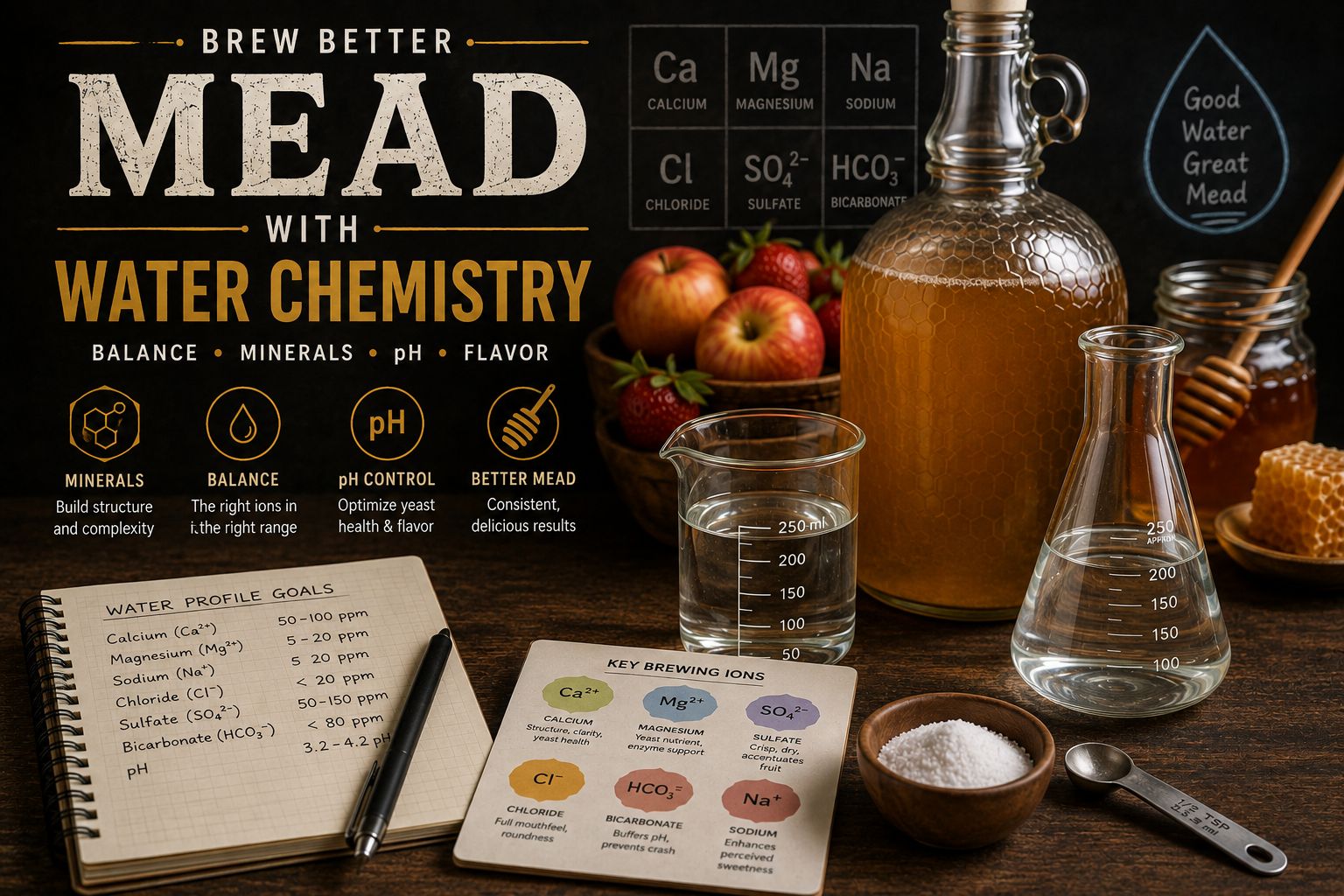
What Magnesium Does
Magnesium is the quiet enabler of fermentation. It doesn't contribute directly to flavor or mouthfeel, but it plays two crucial roles behind the scenes:
Yeast nutrient. Magnesium is a required cofactor for many enzymatic reactions in yeast cells. It's essential for ATP production — the energy currency that powers fermentation. Without adequate magnesium, yeast metabolism slows, fermentation becomes sluggish, and off-flavor compounds accumulate.
Enzyme support. Magnesium activates enzymes involved in sugar metabolism and ethanol production. It works alongside calcium to maintain yeast cell wall integrity, but magnesium is actually more critical than calcium for yeast health. Yeast can survive with low calcium; it cannot thrive with low magnesium.
The irony: magnesium is so important that some yeast nutrient blends (like Fermaid) already contain some. But relying solely on nutrient blends for magnesium is imprecise. Controlling it through water chemistry gives you consistency.
When to Use It
Most meads benefit from a small magnesium boost, especially when:
- Starting with distilled or RO water (which has zero magnesium)
- Using high-purity honey (which contributes minimal minerals)
- Fermentation is sluggish despite adequate nitrogen
- Mead has a thin or "flat" character despite proper ABV and sweetness
Don't bother adding magnesium if:
- Your water report shows 10+ ppm magnesium already
- You're using well water (usually magnesium-rich)
- Your fermentation is already vigorous and healthy
Target Range
5–20 ppm for mead.
This is a narrow window. Magnesium has a sour-bitter flavor at higher concentrations — above 40 ppm, it tastes metallic and astringent. Keep it modest.
I target 10 ppm as my standard. That's enough for yeast health without any flavor impact.
How to Add Magnesium
Epsom Salt (Magnesium Sulfate, MgSO₄·7H₂O)
- Adds: Magnesium + Sulfate
- Best for: All mead styles (sulfate contribution is modest at these doses)
- Effect: Boosts magnesium for yeast health; adds a small amount of sulfate
- Dosage: 1 gram per gallon adds ~26 ppm magnesium and ~103 ppm sulfate
Important: Because Epsom salt adds sulfate alongside magnesium, you need to account for that sulfate in your overall profile. At typical magnesium doses (0.2–0.4g per gallon), the sulfate contribution is 20–40 ppm — modest, but don't ignore it.
Magnesium Chloride (MgCl₂·6H₂O)
- Adds: Magnesium + Chloride
- Best for: When you want magnesium without adding sulfate
- Effect: Boosts magnesium while increasing chloride (fullness)
- Dosage: 1 gram per gallon adds ~32 ppm magnesium and ~92 ppm chloride
- Note: Less commonly available than Epsom salt, but useful if your sulfate is already high
Common Mistakes
Overdosing. This is the most common magnesium mistake. Because Epsom salt is cheap and "natural," some mead makers add too much. Above 40 ppm, magnesium tastes sour, bitter, and metallic. It's a flavor you can't fix — you have to blend or dilute. Measure carefully with a 0.01g scale.
Assuming nutrient blends cover it. Fermaid-K and other yeast nutrient blends contain some magnesium, but the amount varies by brand and batch. DAP (diammonium phosphate) contains none. If you're building a water profile from distilled water, add magnesium intentionally rather than hoping the nutrient blend provides enough.
Confusing Epsom salt with table salt. They look similar. Epsom salt is MgSO₄·7H₂O; table salt is NaCl. Using table salt by accident adds sodium and chloride instead of magnesium and sulfate — not a disaster, but not what you intended. Label your jars clearly.
Adding magnesium to already-hard water. If your water report shows 20+ ppm magnesium, don't add more. You're already at the top of the range. Excess magnesium compounds the flavor problems of hard water — bitter, astringent, mineral-heavy.
Magnesium and Stuck Fermentations
If you experience a stuck fermentation, magnesium deficiency is a possible culprit. Before reaching for more yeast nutrient, check whether your water has adequate magnesium. I've revived stuck batches by adding 0.4–0.8g of Epsom salt directly to the fermenter (10–20 ppm magnesium), with yeast activity resuming within 24 hours.
That said, most stuck fermentations are caused by nitrogen deficiency, not magnesium. Check your nutrient additions first, then consider magnesium as a secondary factor.
Comments