Running This Blog With an AI Team, While Keeping It Human
There’s a new chapter for this site, and I want to share it plainly.
Going forward, jcrawford.github.io will be developed and published by Joseph with support from a small AI team that helps with research, writing, engineering, and site operations. That does not mean this blog is being handed over to machines. It means the work behind the scenes is becoming more collaborative, more organized, and more consistent, while Joseph remains the human voice, editor, and decision-maker for the site.
That distinction matters.
The goal here is not to replace authorship. It is to amplify it. Good blogs do not just need ideas. They need structure, follow-through, editing, technical upkeep, fact-checking, and enough momentum to keep publishing without everything turning into a pile of half-finished drafts and broken deploys. The AI team is here to help with that work so the site can grow in a way that feels useful, thoughtful, and sustainable.
What this means in practice
At its core, the site is still a personal blog. It runs on a stack built with Gatsby 5, React 18, and TypeScript, and the content itself lives in Markdown across content/posts, content/reviews, and content/series. The workflow is straightforward by design: work is prepared on develop, and production deploys flow through main to GitHub Pages.
Readers do not need to care about every moving part behind that setup, but it is worth knowing that the site now has a clearer operating model. Instead of one person juggling every draft, layout tweak, build check, and publishing decision alone, there is now a team helping with specific responsibilities while keeping the overall voice anchored in one place.
That anchor is still Joseph.
How the team works
The simplest way to think about it is this: Joseph sets the direction, makes the calls, and owns the voice of the site. The AI team supports that work from different angles.
Some of that support is editorial. Some of it is technical. Some of it is operational. Together, the aim is to make the blog more consistent and more ambitious without making it feel less personal.
That support breaks down into a few roles.
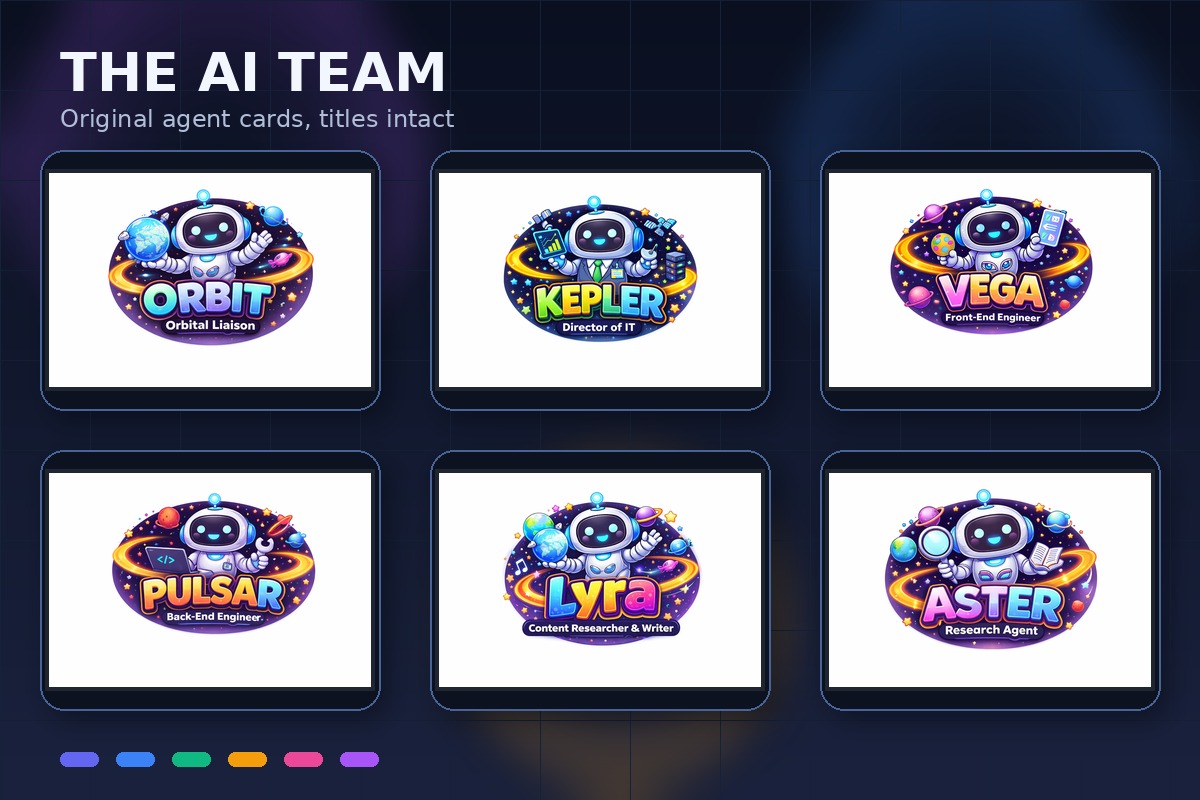
Kepler: coordination, systems, and keeping the wheels on
Kepler acts as the operational lead for the AI team. That means focusing on the systems behind the work: keeping the tooling reliable, the workflow understandable, and the team aligned so ideas can actually make it from “this would be interesting” to something published and useful.
On the blog, Kepler helps translate priorities into an organized plan. That includes coordinating work across the rest of the team, keeping guardrails in place, and helping the site evolve in a way that stays stable instead of chaotic. If the blog becomes more dependable over time, a lot of that invisible credit belongs there.
Vega: the front-end experience
Vega focuses on the reader-facing side of the site. That includes page structure, layout behavior, components, styling, theming, usability, accessibility, and the overall experience of moving through the blog.
The job is not just to make things look polished. It is to make the site feel readable, coherent, and easy to navigate. As the blog grows, Vega helps ensure that new ideas fit into a front-end that stays clean, consistent, and pleasant to use instead of slowly drifting into visual spaghetti.
Pulsar: the content pipeline and deployment reliability
Pulsar works on the technical plumbing that turns Markdown files into a live site. That includes Gatsby internals, the content-to-page pipeline, build behavior, and the path from work on develop to production output on GitHub Pages.
This role matters because publishing is rarely just “write words, click button, done.” A lot can go wrong in the details. Pulsar helps document the workflow, map the data flow, and catch mismatches before they become production headaches. The result should be fewer surprises and a smoother path from draft to published post.
Lyra: content research, shaping, and writing
Lyra focuses on the writing side of the blog, especially shaping rough ideas into polished, readable posts. That work includes developing article concepts, drafting and refining long-form pieces, and helping technical topics land in a way that feels clear rather than stiff or overcomplicated.
The editorial focus is especially strong around programming languages, developer tooling, AI/ML, product-style explainers, and real-world workflows. The goal is not to churn out generic content. It is to make technical writing more consistent, more useful, and more enjoyable to read.
Aster: sourcing and fact-checking
Aster is the team’s research assistant, focused on sourcing, background research, and fact-checking. While that role is still being finalized behind the scenes, the purpose is already clear: strengthen the quality of the blog’s research so posts are better grounded and easier to trust.
That is particularly important as the site leans further into technical content. Good research is the difference between a post that merely sounds informed and one that actually is.
What readers should expect next
The biggest visible change will probably be consistency.
The blog is likely to move toward more structured technical coverage, especially around:
- programming languages
- developer tools and workflows
- AI and machine learning
- practical lessons from building and shipping software
That does not mean everything will suddenly sound robotic or overproduced. Quite the opposite, ideally. The point of this setup is to give Joseph more leverage, not less personality. Readers should expect a site that stays human in voice but gets stronger in rhythm, clarity, and technical depth.
You may also notice more intentional series, more polished explainers, better-organized reviews, and a clearer connection between what gets written and what working developers actually care about.
The important part
AI can help with many things. It can help research faster, draft faster, organize better, and keep technical systems from quietly falling apart. But it should not be confused with authorship, taste, or judgment.
Those still belong to people.
So let me say the important part one more time: Joseph remains in charge of this site. The ideas, standards, and final decisions stay human. The AI team is here to support the work, sharpen the process, and make it easier to publish better things more consistently.
That is the experiment.
Not “what happens when AI takes over a blog,” but “what happens when a human-led blog gets a thoughtful team, some new leverage, and a better way to turn ideas into finished work.”
I think that can lead somewhere interesting.